Showing posts with label Embryo transfer. Show all posts
Showing posts with label Embryo transfer. Show all posts
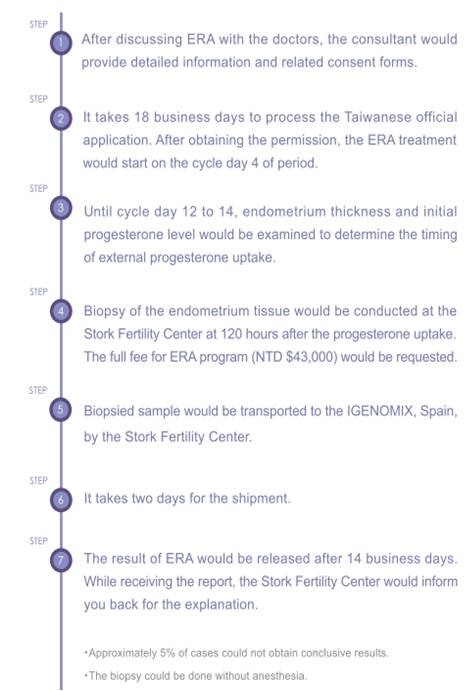
ERA program (ERA procedures)
March 22, 2017

One step to start a family--
When to eat progesterone, transfer...and more!
IGENOMIX, a leading team of reproductive genetics in Spain, has developed ERA to analyze the gene expression of endometrial tissue. This method helps us determine if the endometrium presents the ideal condition for implantation of embryo (WOI, window of implantation), and thus pregnancy rate would be improved.
To know more about ERA: http://taiwanivfsfc.blogspot.tw/2017/02/endometrial-receptivity-array-era.html
Indications for ERA at Stork Fertility Center
Repeated implantation failure after undergoing hysterosalpingogram, hysteroscopy and autoimmune examinations
Repeated pregnancy failure after transferring four Day 5 blastocysts graded above BB
Repeated implantation failure after transferring two euploid blastocysts with PGS
ERA cycle design:
The medications of ERA cycle are different based on the doctors' order. It could be either hormone replacement treatment (HRT) or natural cycle. The HRT is recommended by IGENOMIX, since the time span of priming could be more accurate.

In 10,000 enrolled patients with repeated implantation failure, around 28.6% displayed non-receptive of their ERA assay in a conventional endometrium preparation cycle. In these non-receptive patients, around 85% showed delayed WOI (pre-receptive pattern).

Endometrial Receptivity Array (ERA)
February 20, 2017

Have you ever heard the phrase of personalized precision IVF?
Nowadays, the individualized medicine is more prevalent.
With the improvements in ART,
some patients still suffer by repeated implantation failure.
Why?
It's time to think about "personalized embryo transfer (pET)."
Embryo implantation is a highly complex process incorporating with a healthy embryo, a receptive endometrium, and a molecularly communicative dialogue in between. Until 2016, Stork Fertility Center has comprehensive applied individualized COS, IMSI/ICSI, blastocyst culture, PGS/PGD, donor gametes, and frozen embryo transfer for the cases with specific indications. Moreover, all patients would be requested to take the hysteroscopy, hysterosalpingograrphy, and cervical bacteria culture before entering the transfer cycle. However, still some patients failed after couple of transfers.
Why?
Except the quality of embryo and the physically normal observation of uterus and endometrium (EM) through ultrasound, a hidden culprit must exist in between—the dialogue for permitting implantation. Actually the human endometrium is a dynamic tissue, which undergoes changes during multiple levels in a menstrual cycle. The changes in histological markers, biochemical markers, molecular markers, and transcriptomics (Omics) have been reported in the previous articles. Generally, the period of EM receptivity is known as the "window of implantation, WOI," which opens during the cycle day 19 or 20 and remains open for 4-5 days. During WOI, the EM becomes functionally competent for the embryo implantation.

Using the assisted statistical tool, principal component analysis (PCA), hundreds of transcriptome (gene expression) during different phase of EM (proliferative [PE], early secretory [ESE], mid-secretory [MSE], and late secretory [LSE]) could be analyzed and clustered into four groups: proliferative, pre-ceptive, receptive, and post-receptive.

Through examining these transcriptomes in EM biopsies from different people, several studies found that the WOI is not fixed, as was believed before. It means that a fixed transfer protocol to all the patients could not be applicable. Thus several clinical approaches for detecting the receptivity of EM tissue were developed recently, and the endometrium receptivity array (ERA) was one of them. The ERA was used to analyzed the expression of 238 genes in an EM biopsy obtained from either an HRT or natural cycle. After priming of progesterone in an HRT or of LH in a natural cycle, the EM would be biopsied and analyzed. If the result showed receptive, transferring embryo at the same time in another cycle would be recommended. If the result showed non-receptive, transferring time would be adjusted according to the expressions of pre- or post-receptivity.


Based on the clinical trial of IGENOMIX, Spain, around 30% in the population had a WOI which is not located in the general frame (P+5 or LH+7), and four fifths of these non-receptive are pre-receptive (80%). The introduction of ERA has been reported to solve the problem in part of patients suffering with repeated implantation failure, and thus to increase the success rate in IVF.

At Stork Fertility Center, the indications for ERA is as below,
A. Repeated implantation failure after undergoing hysterosalpingogram, hysteroscopy and autoimmune exams
B. Repeated failures after transferring four Day 5 blastocysts graded over BB in accumulation
C. Repeated failures after transferring two euploid blastocysts in accumulation
Reference: